
On September 3, a fractional CTO named Justin McKelvey published the price of a new kind of trust: 200 to 500 dollars for about two hours of review, paid by someone who built an app without knowing how to code and now wants to put it in front of customers. Read that again. The review is the expensive part. The software was the weekend.
That is what the end of SaaS looks like, and it is not a stock chart. It is a person at a kitchen table describing the tool they have wanted for ten years and getting a working version before dinner. Wall Street calls it the SaaSpocalypse and counts the market cap. I would rather count the tools. This week gave us five dated reasons to think the counting has started, and one reason to think it changes what a studio like ours is for.
The context is a single week in early September. On September 1, the model that builds software got cheaper. On September 3, a contract company started selling its customers the means to build their own agents. On September 4, a work-management company beat its numbers and lost 14 percent in a day. In between, the company whose product is "describe it and it exists" prepared a prospectus at a valuation somewhere between 1.5 and 2 trillion dollars. And on August 31, the tool most teams use to think in shipped a feature called Skills, so that a workflow you invented on Monday can be reused by an agent on Tuesday.
What actually happened to software this week?
On September 1, Anthropic released Claude Fable 5.1 to everyone, on every platform, at roughly 25 percent less than Fable 5 for typical workloads and up to 45 percent less for long agentic runs, according to MacRumors. In June we wrote about the recall of Fable 5, three days after its launch. Three months later the successor is on sale with a lower bill. The tool that builds tools got cheaper on a Tuesday, and almost nobody outside the industry noticed.
On September 3, Docusign reported quarterly revenue of 875.7 million dollars, up 9 percent, and raised its outlook for the year. Agent Studio, launched in August, lets customers build, govern and deploy their own agents for playbooks, compliance audits and vendor pricing. A company that sells contract software is now selling the means to build the contract tool yourself. Its CEO said the agents "are now securely executing contract workflows end-to-end." That sentence used to describe an employee.
On September 4, Asana beat expectations and fell 14 percent before lunch. AI Studio and AI Teammates brought a quarter of its net new recurring revenue, up from 17 percent a quarter earlier. Gross margin slipped because AI compute has a meter on it. The market read the two facts together: the company that sold seats is now selling something a customer could build, and paying for the electricity to sell it.
Between September 2 and 5, The Information and then Venture Atlas reported that Anthropic planned to file its prospectus after Labor Day, targeting a valuation of 1.5 to 2 trillion dollars and a raise above 60 billion, before the timeline slipped to mid-October. You can argue about the number. You cannot argue about what it prices: a product whose entire promise is that a sentence becomes software.
And on August 31, Notion shipped Skills, reusable saved workflows, plus private draft pages for half-formed ideas, three days after letting its agents propose edits that a human approves line by line. Put the five together and the pattern is plain. The companies that sell software are now selling the ability to make software. Per-seat pricing is the casualty, and the person at the kitchen table is the beneficiary.
The tool you have in mind is now a weekend project
The most honest account of this shift I have read this year is not a report. It is a blog post by Francis Irving, published on August 13, about the three apps he built for himself: a places app because Google Maps lists kept zooming out on him, a people app that uses spaced repetition to train his memory for faces (he has prosopagnosia), and a custom Spotify player because Spotify never gave him folders. Total cost, an 18-pound monthly Claude plan.
"They're dangerously close to something other people could use. If I'd written these 5 years ago, I'd definitely be marketing them and trying to get users. Right now though that feels slightly… exhausting?"
That quote is the whole shift in three sentences. For twenty years the only way a good tool reached you was through a company: a founder, a pitch deck, a pricing page, a plan per seat. Now the tool reaches you through you. Nobody markets it. Nobody has to.
It is happening inside companies too, and not in the IT department. Hudson Labs' July research on software insourcing quotes Jack Henry, a financial technology firm, on an internal travel-program app built by a non-technical associate, "allowing us to meet a business need without licensing additional software." The same company has nearly one hundred approved AI tools in use. The person who needed the tool made the tool. The procurement cycle was a lunch break.
McKelvey's September 3 method is worth reading precisely because it is not a developer's process. One page of spec before the first prompt. The smallest version first: one screen, one action. One feature per prompt. Commit every working state. Try to break it with empty forms and two tabs. Then pay a human to look before anything touches money or personal data. That is a cook's discipline, not an engineer's: mise en place, taste as you go, and do not serve the chicken raw.
Why does this reach the studio, not just Salesforce?
Retool surveyed 817 people who build software inside companies: 35 percent had already replaced at least one SaaS tool with a custom build, and 78 percent planned to build more this year, as LeadDev reported on July 8. Klarna switching off Salesforce and Workday is the example everyone quotes. The one I keep coming back to is smaller. Warp, a developer-tools company, moved its marketing site off Framer to an in-house build and replaced its documentation platform with something it wrote itself.
A website is a SaaS subscription too, seen from a certain angle. If a client can rebuild a CRM in a quarter, they can rebuild a landing page in an evening, and some of them will. Praveen Jonnala, a CIO writing in CIO on May 20, put the mechanism in one line: "The moat was never the code. The moat was the cost of writing the code." Studios had a smaller version of the same moat. The cost of building the screens.
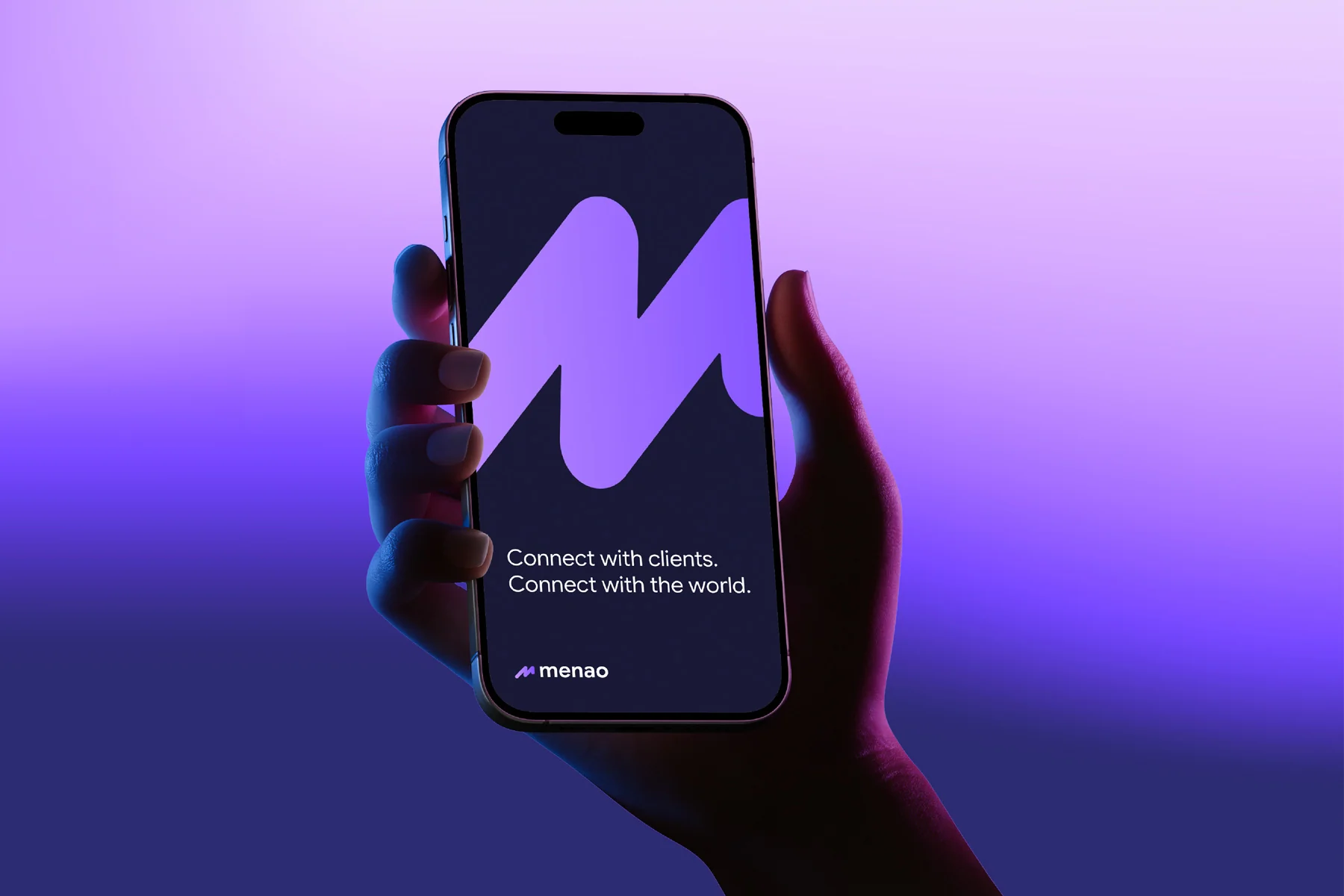
So what does a studio own when the screens are free? The rules. Menao, a B2B app for artisans, needed a brand before the founders could even brief a UX/UI studio, because the product did not exist yet. We designed the rules rather than the screens: a modular logo, a distinctive purple palette, an icon construction grid, and a brand book that was not made for investors. It was made for the dev team to open on day one and start building from. In 2026 that dev team may be one founder and an agent. The book is the same object. Its reader has changed, and the reader now works at 2 a.m. without asking questions.
That is why we now think of a brand system as something a machine has to be able to read: tokens, type scales, component rules, tone, written so that a tool built at a kitchen table on Saturday still looks like the company on Monday. The deliverable moves upstream. It stops being the site and starts being the thing every site, tool and agent will be built from.
Is the door between design and development finally open?
The wall came down in stages this year, and this week added a brick to the pile. On September 1, Figma made generative plugins and shaders publishable, with code access and an MCP server so that agents can read the file. Since May 28, Figma Make has worked directly on a local codebase: a designer selects an element in the running product, changes the spacing or the colour, and the agent finds and edits the code. The change becomes a local commit and then a pull request with the designer's name on it. The two Figma authors wrote the line I would frame: "Design vs code is a false dichotomy."
We wrote in April that Claude Design was the end of the handoff, and in June that design tools had become agents. What this week adds is the human consequence. The handoff used to be a document: a PDF, a Zeplin link, a Slack thread called "final final." Now it is a conversation inside one file. A designer changes a token and the diff carries her name. A developer picks a typeface because the designer is at lunch and the agent offered three. Both are fine. The role in the middle, the one who translated, is thinning.
Think of the open kitchen. For a century restaurants hid the cooking behind a door, and the waiter carried plates and complaints in both directions. Then the wall came down: the cook sees the guest, the guest sees the flame, and the dish changes because of it. The translation layer did not get more efficient. It disappeared, and a different skill became visible, the person who can taste, plate and talk at once. That is the design engineer everyone is hiring, and increasingly what an art director does: you review the agent's diff the way an editor reviews a draft.
Human, not smaller
This is the part the "end of SaaS" stories miss, and the reason I wanted to write this one. The interesting news is not the market cap. It is who is building and what they build. An app to remember faces. A travel-program tool by someone whose job title has nothing to do with software. A music player with folders. These tools are shaped like a person, not like a market segment, and no product manager would ever have prioritised them, because the market for a face-recognition trainer for one man in London is one man in London.
SaaS was the food court. The same menu for everyone, the ketchup in the same place, the seat price on the door. Personal software is the kitchen table. The recipe changes because your kid does not eat onions, and nobody files a feature request. I find that more moving than any productivity statistic, because it returns software to what it was for the first hobbyists: something you make because you need it, for the people in the room.
For a brand, this has two consequences, one outside and one inside. Outside, your customers will increasingly meet you through tools they built: an agent that reads your site, a dashboard that pulls your prices. Your brand has to survive being taken apart and reassembled by a stranger's tool. That is a systems question, not a logo question. Inside, your own team will build forty small tools this year. If each one looks and sounds different, the brand dissolves inside the company before it dissolves outside it. The brand book was once for agencies. Now it is for everyone in the building with a prompt.
The risk: twenty-five million half-finished apps
Lovable, the Stockholm company that made "build it by chatting" a category, says 25 million projects were built on it in its first year, a figure repeated in a September 4 founder guide to the tool. Most of those projects are unfinished, and that is fine. Most sketches are unfinished. The trouble starts when a sketch handles a credit card.
McKelvey's list of red flags reads like an inspection report for a kitchen that has never been inspected: API keys sitting in the front end, pages reachable without logging in, one enormous file, failures that say nothing. His shortest rule is the best one. "Runs" is not "complete." Asana's gross margin lost 80 basis points to compute in a single quarter. Somebody pays for the tokens, and the tool that feels free has a meter you have not seen yet. And Klarna's CEO, who did switch off Salesforce, named the hidden cost in the LeadDev piece: the switching cost of the data. Your own tool owns your data, and then you own the backups.
There is a design risk too, and it cuts against my own argument. If everyone builds from the same components with the same agent, everything built at home starts to look like the same home. I wrote this morning about what a brand still owns when texture is free, and the same logic applies to tools: a personal app can be personal in function and generic in form. That is exactly where design comes back in.
And the honest tension for us: I am not sure the studio survives every version of this. If a client's agent can read our brand book and build the site, the invoice for the site goes away. We are betting the invoice for the book gets bigger, because the book is now read by more builders than ever. It is a bet. Studios that keep selling screens are making a different one.
What should a founder or creative director do next week?
- Print your subscriptions. Mark the ones a person on your team could rebuild in a weekend. Pick one, and only one, to try.
- Write the one-page spec before the first prompt. If you cannot write the page, you do not know what you want, and the agent will decide for you.
- Before anyone builds anything, write the rules: type, colour tokens, tone, the five components you always use, in a file an agent can read. Every tool built this year should open with that file.
- Pay for the two-hour review before a home-built tool touches money or personal data. It is the cheapest insurance in software.
- Give your designers a branch. Let one of them ship one change to production this month, with their name on the pull request. Then watch how the conversation between design and development changes.
The end of SaaS is not a crash. It is a move. Software is leaving the office park for the kitchen table, and the kitchen table is where your brand will be tested next, by people who will never read your guidelines and will build with them anyway. Set the table before the guests arrive.
Sources
- MacRumors: Anthropic Launches Claude Fable 5.1 With Lower Costs and Fewer False Positives (September 1, 2026)
- Figma Blog: Behind the build, generative plugins and shaders at Figma (September 1, 2026)
- Justin McKelvey: How to Vibe Code in 2026, the 7-step method I hand founders (September 3, 2026)
- PR Newswire: Docusign Announces Second Quarter Fiscal 2027 Financial Results (September 3, 2026)
- Venture Atlas: Anthropic to unveil IPO prospectus after Labor Day (September 3, 2026)
- Investing.com: Asana earnings analysis, questions answered and next catalysts (September 4, 2026)
- Mean CEO: Lovable News, September 2026, startup edition (September 4, 2026)
- Releasebot: Notion release notes, Skills, private drafts and proposed edits (August 28 to 31, 2026)
- Francis Irving: Vibe coding personal apps in mid-2026 (August 13, 2026)
- Hudson Labs: AI Replacing SaaS, 2026 software insourcing trends (July 14, 2026)
- LeadDev: Developers on the frontline of the SaaS replacement wave (July 8, 2026)
- CIO: The SaaS reckoning, why AI is about to reprice enterprise software (May 20, 2026)